

Upcoming Free Webinars
JOIN US! Webinars are organized by the PHO Education Committee and designed to present a range of topics of interest to the PROMIS community. The sessions always include time for Q&A.
Watch for announcement of the next PHO Journal Club
December date to be announced
Check out our previous webinars
An Evaluation of Existing Patient-Reported Outcome Measures for Use in Long COVID Trials: A Qualitative Study
Presented September 23, 2026
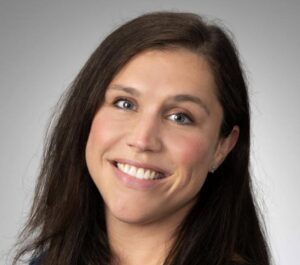 Long COVID is a relatively new yet devastating phenomenon. Existing measures repurposed from other conditions could facilitate rapid evaluations of needed treatments, but they currently lack sufficient validity evidence in the Long COVID population. As part of the Researching COVID to Enhance Recovery Clinical Trials (RECOVER-CT) initiative, we conducted a qualitative study to evaluate item comprehension and content coverage of selected patient-reported outcome measures (PROMs) for use in Long COVID clinical trials. Due to the heterogeneous experience of patients with Long COVID, we evaluated content coverage of the selected PROs as a set.
Presenter: Christina Zigler, PhD, MSEd
Associate Professor, Physical Medicine and Rehabilitation, University of Pittsburgh School of Medicine
Moderator: Jason Raad, PhD, University of Pittsburgh
Leveraging Workflow Skills to Collect Measures
Presented August 18, 2026
This presentation summarizes a strategy to develop a workflow for referral and collection of outcomes. The case of developing referrals to Arthritis-Appropriate, Evidence-Based Interventions (AAEBIs) in partnership between healthcare and a community care hub.
Presenter: Joy D. Doll, OTD, OTR/L, Program Director, Health Informatics, Associate Professor, Creighton University
Moderator: Sam Pak, PT, DPT, ACHIP, University of California, San Francisco
Personalized Recovery Trajectories Can Enhance the Clinical Utility of Patient-Reported
Outcome Measures
Presented July 22, 2026
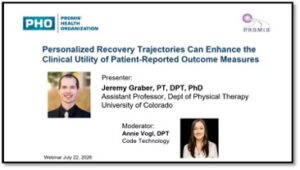 Patient-reported outcome measures (PROMs) capture important information about patients’ self-reported health, function, and quality of life. However, PROMs can be difficult to interpret and apply towards clinical decision making. These challenges could be addressed using personalized recovery trajectories. Personalized recovery trajectories are created from predictive models, and they are conceptually similar to childhood growth charts. Just as parents and pediatricians use growth charts to monitor a child’s growth over time, clinicians can use personalized recovery trajectories to monitor a patient’s self-reported health status over time using PROMs.
Presenter: Jeremy Graber, PT, DPT, PhD, Assistant Professor, Department of Physical Therapy, University of Colorado
Moderator: Annie Vogl, DPT, CODE Technology
PHO Journal Club: Discussion of selected articles from Advances in Patient-Reported Outcomes
Presented June 17, 2026
Click for Journal Club summary
The inaugural PHO Journal Club featured presentations and discussion with authors of two selected articles published in Advances in Patient-Reported Outcomes (APRO).
Moderator: Kelly Hynes, MD, MS, FRCSC, FAOA, FAAOS, Washington University St. Louis
APRO Editor-in-Chief: David Cella, PhD, Northwestern University Chicago
Presenting Authors:
John C. Licciardone, DO, MS, MBA, FACPM, University of North Texas Health Science Center, Fort Worth, TX
Licciardone J, Fortier N, Hall J …
The association of race and social disadvantage with chronic pain outcomes. Advances in Patient-Reported Outcomes, 2026; 2, doi:10.1016/j.apro.2026.100316
Derek Falk, PhD, MSW, University of Oklahoma Health Campus, Oklahoma City, OK
Vazquez C, Falk D, Urbanski D …
The relationship between social media use and loneliness across the lifespan in the United States: Population- based study using Health Information National Trends Survey data. Advances in Patient-Reported Outcomes, 2025; 1, doi:10.1016/j.apro.2025.100196
Integrating PROMIS in Arthritis Care and Research
Presented March 24, 2026
Click to view recording
Webinar summary 3-24-26 PROMIS in Arthritis-Bingham
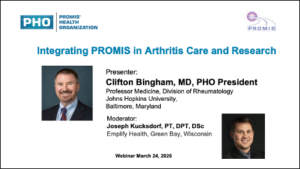 This presentation focused on how PROMIS measures have been integrated into the routine care of patients with rheumatoid arthritis over the last 10 years in the Division of Rheumatology at Johns Hopkins University in Baltimore.
4) Use of PROMIS measures in registries and clinical trials
Presenter: Clifton Bingham III, MD, Professor of Medicine, Division of Rheumatology, Johns Hopkins University, Baltimore, MD USA
Moderator: Joseph Kucksdorf, PT, DPT, DSc, Emplify Health, Green Bay, WI USA
PROMIS Preference Score (PROPr) Valuation in the Netherlands - First Results
Presented December 10, 2025
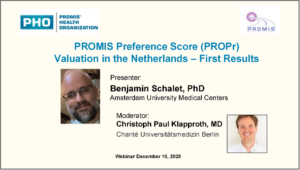 Health economists use preference-based quality of life instruments to conduct cost-benefit analyses, which help inform policy makers about the value of interventions. The most commonly used measure for this purpose is the EQ-5D-5L. The PROMIS-Preference measure (PROPr) is a relatively new instrument developed in the US that provides possible advantages in terms of health range and efficiency. However, the underlying value set is based on data from a US-based sample. Dr Schalet will discuss the current development of a country-specific PROPr value set, reflecting the preferences of a Dutch population, and provide a short introduction to this topic.
Presenter: Benjamin Schalet, PhD, Universitair Docent (Assistant Professor), Amsterdam University Medical Centers, Department of Epidemiology and Data Science, Amsterdam, The Netherlands
Moderator: Paul Klapproth, MD, Charité Universitätsmedizin Berlin, Germany
PROMIS-16 in the PROMIS Arsenal of Patient-Reported Outcomes Measures
Presented September 17, 2025
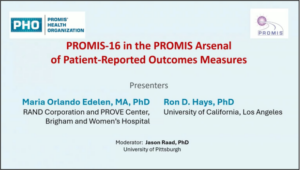 The Patient-Reported Outcomes Measurement Information System® (PROMIS®) 16-item Profile (PROMIS-16) is minimally burdensome health-related quality of life profile measure that yields eight scale scores (physical function, ability to participate in social roles and activities, anxiety, depression, sleep disturbance, pain interference, cognitive function, and fatigue), physical and mental health summary scores, and the PROMIS Preference (PROPr) score. This presentation will summarize the development and psychometric properties of the PROMIS-16 and discuss how it fits within the PROMIS arsenal of patient-reported outcome measures.
Presenters:
Maria Orlando Edelen, MA, PhD (Quantitative Psychology), Senior Behavioral Scientist, RAND Corporation, Boston
and Adjunct Faculty at the Patient Reported Outcomes, Value and Experience (PROVE) Center
Department of Surgery, Brigham and Women's Hospital, Boston
Ron D. Hays, PhD, Distinguished Professor, Division of General Internal Medicine and Health Services Research, University of California, Los Angeles and Affiliated Adjunct Researcher at the RAND Corporation
Moderator: Jason Raad, PhD, University of Pittsburgh
Getting Started with PROMIS
Presented August 13, 2025
Click here to view the recording

This session will provide guidance on how to select and access PROMIS measures. PROMIS domains and measure types (including CATs, fixed forms, profiles, and screen-to-CATs) will be discussed and demoed. The session will include navigation of www.healthmeasures.net to access measures and related resources.
Presenters:
Michelle Langer, PhD, Executive Director, Northwestern University Center for Outcomes Research and Education, Chicago
Nejma Benzaari, MSPH, Senior Program Coordinator, HealthMeasures, Northwestern University, Chicago
Moderator: Joseph Kucksdorf, PT, DPT, DSc, Emplify Health by Bellin, Green Bay
Understanding Minimal Important Change (MIC)
Presented June 12, 2025
This session will cover the concept of minimal important change (MIC) and how to use it. The advantages and disadvantages of existing methods for calculating the MIC will be presented. Plausible MIC values for PROMIS will be discussed, and ample time will be allocated for Q&A.
Presenter: Caroline Terwee, PhD, Amsterdam University Medical Centers, Netherlands
Moderator: Paul Klapproth, MD, Charité –Universitätsmedizin Berlin, Germany
Making PROMIS Work: Practical Strategies for Clinical Integration of PROMIS
Presented May 22, 2025
Learn as panelists share strategies for implementation of PROMIS in their respective healthcare institutions.
Panelists:
Kelly Hynes, MD, MS, Washington University, St. Louis
Tiffany Kendig, DPT, MPH, CLT, Select Medical, New York
Joseph Kucksdorf, PT, DPT, DSc, Emplify Health by Bellin, Green Bay
Eric Makhni, MD, MBA, Henry Fort Health, Detroit
Moderator:
Sam Pak, PT, DPT ACHIP, University of California, San Francisco
Common Metrics vs. Measures: PROMIS Physical Function as an Exemplar
Presented April 14, 2025
There are many different outcome measures that quantify the same or similar constructs. This heterogeneity makes it challenging to conduct large-scale research and quality measurement. Requiring uniformity of measure selection may not always be practical. Instead, measures can be placed on the same metric, allowing commensurate scoring. PROMIS Physical Function T-score metric will be used as an exemplar metric on which scores from other measures can be placed and commonly understood. Both linking of other patient-reported outcome measures and performance-based measures will be discussed.
Presenters:
Aaron Kaat, PhD, Northwestern University, Chicago, Illinois USA
Gregor Liegl, PhD, Charité Universitätsmedizin Berlin, Germany
Moderator:
Jason Raad, PhD, University of Pittsburgh